Recently, Port Phillip Mayor Alex Makin appeared alongside his City of Yarra counterpart, Stephen Jolly, on the front page of The Age talking about amalgamation of councils as a way of dealing with budget pressures. City of Melbourne Lord Mayor Nick Reece was notable by his absence.
Interest spiked briefly and then subsided. The news didn’t arouse citizen outrage, as such an announcement would have done twenty years ago when councils were amalgamated by Premier Jeff Kennett.
Later, Makin said it wasn’t about amalgamation really. It was about how Councils will fund the increasing range of services they are expected, or required, to deliver. Take pruning trees around electrical powerlines for example. Council has a legislated responsibility to clear trees from around power lines to minimise fire risk but the considerable costs are borne by ratepayers.
At the same time the state government limits the amount of revenue councils can generate from rates through the imposition of a rate cap.
Makin called for an agreement between state and local government about which level of government was best placed to deliver different services and how they would be funded.
Flashback to to Council amalgamations in the 1990s
Communities in Port Melbourne, South Melbourne and St Kilda strongly opposed council amalgamations in the 1990s. The Port Melbourne community led a particularly vigorous campaign against amalgamation using the banner Vintage Port, worth preserving.
So strong was the attachment to the former municipality that a wake was held at the Port Melbourne Town Hall to mark its demise.
The newly elected Port Phillip Council respected local place identity and place attachment by treating each of the former municipalities as ‘neighbourhoods’.
In December last year, the government announced that VicHealth would be abolished and absorbed into the Department of Health as part of a wide ranging independent review of public service entities and advisory bodies. VicHealth was the first organisation in the world dedicated to health promotion. It was funded by a tax on tobacco.
St Kilda artist Julie Shiels responded to the community mood of the time. She received funding from VicHealth for a public art project, Margins, Memories & Markers. It resulted in 6 permanent artworks across Port Phillip and 28 bronze plaques markers. VicHealth saw the health benefit of supporting community based art projects around place and identity.
The artworks emerged from a series of workshops where people shared stories of their places which were collated into Neighbourhood Stories.
Artists responded to those stories.
Perhaps the most well known and loved of these artworks is Tommy’s Story, a set of sculpted working man’s clothes on the beach wall. They relate to the story of Tommy, a wharfie, who left his clothes on the beach, and swam to work, there to dress in his work clothes.
Lesley Truffle spoke with the sculptor Bill Perrin to find out how he achieved the detail of this work.

Port Stories
Artist Dianna Wells and collaborator Helen Bodycomb captured the essence of the Port Stories – a sense of Port’s strong sense of identity, and the connection with the piers – in a series of text based artworks.
The words “You can take the boy out of Port but you can’t take Port out of the boy” were etched in Port’s red and blue into an alcove near Station Pier.
When attempting, and failing, to photograph the work, I spoke with two Canadian cruise ship visitors who had paused to look at the work.
“Ah”, she responded, “we have that back home – ‘You can take the boy out of the prairie but you can’t take the prairie out of the boy’.
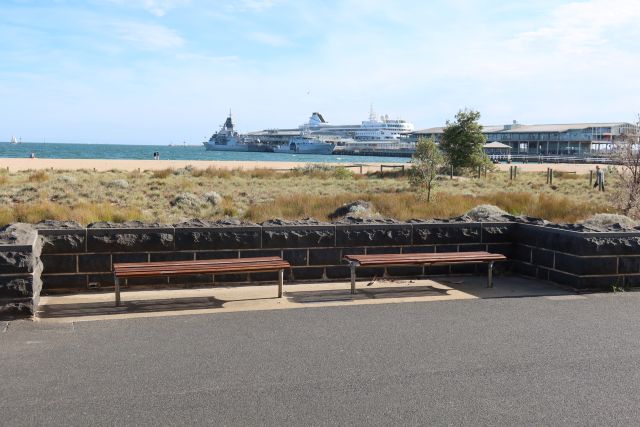
In another alcove, under the benches in dialogue with Station Pier, the poignant text “Don’t forget to write’. The plaques are quiet and easy to miss, but someone has put their stamp on the work by creating an envelope.
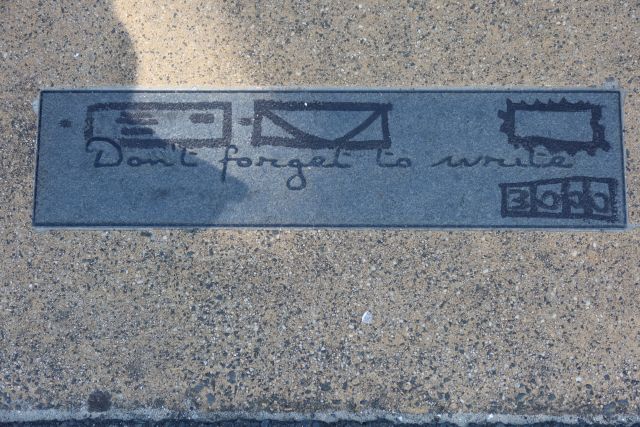
Those messages of loss and longing embedded into the fabric of the foreshore were felt so deeply twenty years ago.
That sense of Port’s identity is fading now, along with the artwork, as is the memory of those forced council amalgamations. It’s hard to imagine people rallying to the defence of the City of Port Phillip. Place associations now are more immediate, more micro-local.
Those amalgamations of the early 2000s, it seems, have not achieved their promise of financial sustainability for local councils. Will Mayor Makin, with the support of other councils, progress that agreement between state and local governments?.
VicHealth is not going down without a fight. The Opposition and Greens are unlikely to support the changes required in the Upper House.
Look at all six artworks in the brochure margins, memories & markers