Of the 46,000 trees making up the City of Port Phillip’s urban forest, this week’s post appreciates the trees of Edwards Park in Port Melbourne.
The City of Port Phillip’s Urban Forest Strategy says: Future-proof the urban forest, using succession planning and a new planting palette that ensures resilient and diverse species selection; and develop specific management plans for iconic Palm and Plane trees
Edwards Park is an example of this strategy. Different kinds of trees have been planted over time, adding interest, shade and habitat.
Edwards Park was once part of the Sandridge Lagoon. Its present location is indicated on the map below.

While parts of the Lagoon to the north were filled and sold for housing, the park was gazetted as an ornamental reserve under the management of the Port Melbourne Council in December 1897. The 1.21 ha Park continues to adapt to changing community needs. Over time, Edwards Park has grown with the addition of parts of the road reserve of Esplanade West and East.
It’s perhaps not surprising that the first trees planted were chosen to put a ‘stamp’ on a space that the Council and its citizens were keen to put behind them. In those early days of the park, a dense planting of Pines radiata gave definition to the perimeter of the Reserve. Canary Island Date Palm trees were planted in the late 1920s, flanking the radial paths that bisect the Reserve. Canary Island Date Palms have been an enduring choice for a signature urban tree. The palm trees are now nearly one hundred years old. Elsewhere in Port Phillip, some palms have been infected with Fusarium wilt, a disease for which there is no cure at this time. Diseased trees need to be removed so as not to infect others. I seem to recall that one tree was removed from Edwards Park. Can anyone confirm?

There was not much change to tree composition, apart from the palm trees gaining stature, until the early 2000s.
As the new Port Phillip Council settled into its post amalgamation phase, attention turned to tree planting, and a preference for Australian trees. An avenue of Angophora costata was planted on either side of the path along Esplanade East. Early on, as those trees were taking root, one was lost in a storm leaving a gap in the avenue. Angophora have opposite leaves, while Eucalyptus have alternative leaves on adult trees.

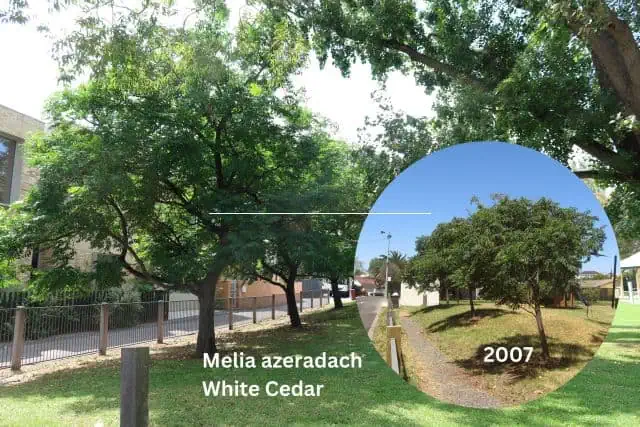
Next to be planted were the White Cedars When the trees were planted, a swale or shallow channel was created alongside them. When it rains, the trees benefit from the retained moisture. This reflects changing tree planting practices during the Millennium drought.
Next came the Golden Elms lining the southern side of the Park. Planted on a dull day in 2017, they are thriving having been planted in a more rain abundant decade than the White cedars. The trees, which grow wide as well as tall, are already offering beautiful, dense shade on hot summer days.

Trees are essential infrastructure. They provide shade, absorb stormwater, provide oxygen, improve mood and our sense of wellbeing.
Let’s appreciate the trees close to us.