Since 1 January, Westgate Park has been managed by the City of Melbourne. Before that, it was managed by Parks Victoria.
Westgate Park is now part of the network of green spaces in Melbourne that have been brought together under the banner Garden City. Lord Mayor Nick Reece is an enthusiastic champion of the Garden City. $26 million is allocated in the City of Melbourne’s draft budget 2026/27 for the Garden City.1
(This is a bit confusing to Port people where Garden City is associated with bank houses.)
The change at Westgate Park, even after five months, is obvious. Two gardeners are in the Park five days a week. The grass is mown, the beds are neatly edged and freshly mulched and the bins are emptied. These are what Joan Nassauer called ‘cues to care’2 When a place is looked after, people feel more at ease.

Friends of Westgate Park amalgamated with Skinc (St Kilda Indigenous Nursery Cooperative) in 2018 to form Westgate Biodiversity: Bili Nursery & Landcare (WBBNL). Since then their goal has been to combine the two parts of their operation – the nursery, and landcare – on one site at Westgate Park.
At present, Bili Nursery is located at 525 Wlliamstown Road, next to the Port Melbourne Football ground in the City of Port Phillip. Bili Nursery will need to leave the site in late 2026 or early 2027 as the City of Port Phillip needs the site as part of a new sports precinct to be created with the adjacent site at 509 Williamstown Road, purchased in 2023.
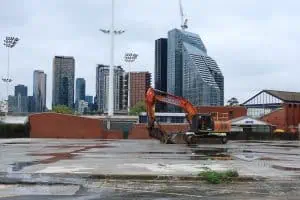
The designated new nursery site is in Westgate Park, known as the Wharf Road triangle. The site needs to be prepared and levelled, and appropriate nursery facilities created. Even the most modest facilities will take time to prepare and be delivered.
Bili Nursery provides a unique service in inner Melbourne. It is likely that every shrub, wildflower and grass growing in the parks and reserves of the City of Port Phillip began life at this nursery, either grown from seed, cutting or division.
Bili Nursery cultivates plants not only for the City of Port Phillip, but for other Councils as well as landscapers and the public.
Mars Reid and Rhod Cunningham at Bili Nursery are plant whisperers, able to coax growth out of almost every seed or cutting.
Over the summer months, Rhod and Mars head out of town collecting seed. As urban development proceeds on the fringes of Melbourne, sites for seed collection are being lost.
This year, they harvested seed from roadsides just ahead of the fires in North East Victoria. They found the summer season erratic. Usually reliable plants did not yield seed. They make valuable observations about how plants are responding to the changing climate.
The seed is then cleaned by volunteers and stored securely for planting at the right time.
Both the City of Port Phillip and the City of Melbourne have new zest for urban nature and biodiversity.
In the City of Port Phillip, Danks St, once a tired median strip, is becoming the biodiversity corridor imagined in 2019. The City is looking to use to use Danks St to plant rare plants in order to harvest seed locally.
Bili Nursery has the privilege and responsibility of cultivating rare plants for re-introduction at Westgate Park that have not been seen in this part of Melbourne since the earliest days of colonisation including the recently adopted floral emblem of Melbourne, the critically endangered Swamp everlasting Xerochrysum palustre.
The importance of Bili Nursery’s work cannot be overstated.
While the improvements in park management are hugely welcome, progress towards the nursery re-location has been slower.
WBBNL is seeking active support from the City of Melbourne in facilitating the move of Bili Nursery to Westgate Park.
Janet Bolitho is on the committee of Westgate Biodiversity: Bili Nursery & Landcare
1 There is no allocation for capital expenditure at Westgate Park in the City of Melbourne draft budget
2 Joan Nassauer 1995 Messy Ecosystems Orderly Frames
These underlying perceptual, cultural, and social mechanisms are immediate recognizability, communication of caring human intention or presence, and a consistency with local cultural traditions or social norms for landscape appearance.