
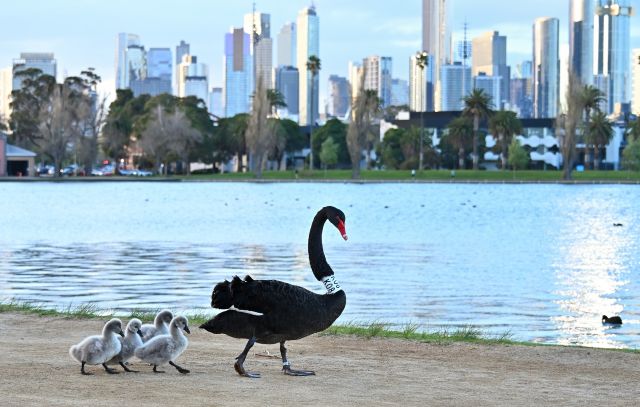
Black Swan Lake
Albert Park Lake is most strongly associated with sport and the Grand Prix.
The 4.8 km circuit around the lake is ideal for walking and running. The lake’s distinctive shape, with its bends and straights, creates challenging conditions for the Grand Prix.
But the life, the natural life, of the lake itself gets less attention.
Albert Park Lake is contained within its concrete walls, bounded, and isolated. An island of a lake, long identified for recreation, rather than ecology.
About twenty years ago, during the millennium drought, when low lake levels grounded sailing boats, an ambitious project brought stormwater from the Hannah Street catchment into the lake to top it up. Reed beds were planted along the lake edge to filter the stormwater before it made its way into the lake. Those reed beds have formed a tall, dense system providing habitat for birds. It’s now nominated a conservation zone where no fishing is allowed.
During COVID lockdown walks, Kelly Brennan began taking a closer interest in the life of the lake, and in particular the black swans. Her interest and commitment has deepened.
She’s been following the breeding cycles of the black swans for several years now. Her observations are assisted by being able to identify the swans through the numbers on their banded collars.
The collars are part of a twenty year long University of Melbourne citizen science project, MySwan. The light weight plastic collars – black for males, white for females – enable easy identification from a distance so the swans can be observed without intrusion. The loose bands cause no harm to the swans.
Male and female black swans form long and mostly enduring pair bonds that last for many years.
In October, Kelly was excited to see two cygnets hatch to K12, a five year old female, and L81. She looked out for all the newly hatched cygnets, posting regularly on the Cygnus Atratus – Black Swans of Albert Park facebook page as the cygnets grew.
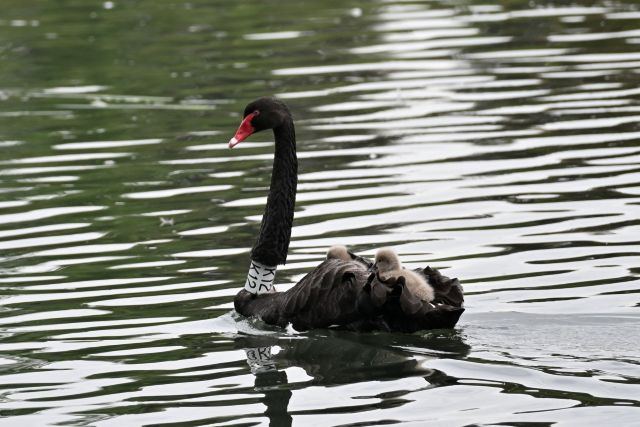
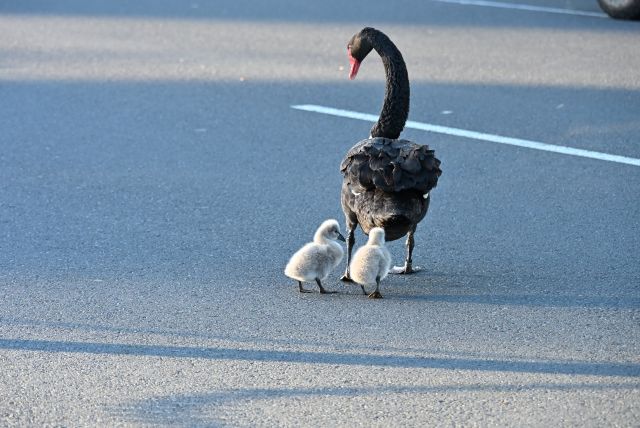
In December, K12 was rescued with a fish hook in her leg. The hook was removed but she developed an abscess and the decision was made to euthenise her.
Now L81 watches over the two maturing cygnets alone.
Discarded fishing material is just one of the many threats faced by Albert Park’s black swans.
Black swans are almost entirely vegetarian. They feed mainly on algae and submerged weeds and sometimes graze on the grass.
Feeding bread to the swans can lead to ‘Angel wing’ syndrome. Angel Wing occurs in young birds when their flight feathers are growing and become too heavy for the wrist joint supporting them. Unable to fly, the birds are vulnerable to predation from off leash dogs, and foxes.
In prolonged hot and dry weather, such as we’ve been having laterly, the lake is depleted of oxygen which leads to outbreaks of Avian botulism. The spores, always present, are activated in hot, dry conditions. It’s absolutely essential that infected birds are disposed of promptly to reduce the spread of the disease. Lake ALIVE! estimate that about 800 birds (not all swans obviously) have been lost to botulism.
At the end of this ‘sad, sad’ 2025 breeding season, seventeen cygnets hatched but only nine survive.
In 2024, fifteen cygnets hatched and twelve survived.
In 2017, the state government passed the Yarra River Protection (Wilip-gin Birrarung murron) Act. It introduced the concept of the river as a ‘living entity’. Wilip-gin Birrarung murron means ‘to keep the River alive’ in the Woi-wurrung language.
Thinking of rivers as living entities is gaining traction. On 23 December 2025, the government introduced planning controls to protect seventeen waterways in metropolitan Melbourne and the surrounding region.
The planning practice note which accompanies this change includes this statement: ‘Recognising waterways as living entities acknowledges that rivers, creeks, wetlands, other waterways and their surrounding lands are alive and interconnected. It affirms their inherent right to exist, thrive and evolve‘.
For too long, Albert Park Lake has not been regarded as a living waterbody. Instead, it has been seen as an amenity and a backdrop to events.
Lake ALIVE!, through fabulous photography and engaging commentary, is encouraging us to see black swans in all their magnificence as well as the trials that they face.
Rather than a plaque, Kelly remembers L29, one of two swans found dead in the north eastern ponds from botulism, by raising the issues faced by black swans with member for Albert Park, Nina Taylor.
My Swan University of Melbourne
Note that the links below are to facebook pages.

Leave a Reply