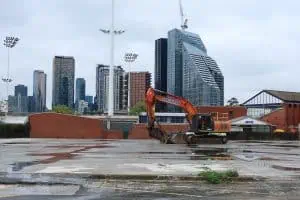
Planning Minister Sonya Kilkenny approved NEXTDC’s M4 AI Factory on 16 January, as reported on Port Places. The facility will be next door to Westgate Park on the former Herald and Weekly Times site at 127 Todd Road.
Renders on the Architectus website show what the data centre will look like.
Since then, debate about AI has intensified. Community concern has grown about the energy and water used by hyperscale AI data centres. There is also concern about land earmarked for housing being used for data centres.
In March, the Australian Government released a statement of expectations for data centres. Expectation 3 relates to sustainable and efficient water usage.
To minimise adverse effects, data centres should:
- cover their share of infrastructure and delivery costs
- build resilience into operations to mitigate the impacts of water disruptions, drought and climate change
- provide ongoing transparent reporting about their water usage and efficiency.
Last week, in an address at Sydney University, the Prime Minister responded to these growing concerns while embracing the opportunities that AI promises. He undertook to introduce legislation into the Parliament in early 2027 to establish a set of Australian Standards for AI.
Late last year Australian data centres came together to form an industry group, Data Centres Australia. It is chaired by NEXTDC’s CEO and Managing Director, Craig Scroggie.
The industry is impatient. In the race for investment in data centres, Data Centres Australia argue that unless regulatory certainty is provided quickly, that capital will be invested elsewhere.
NEXTDC’s M4 data centre promises on-site solar and microgrids to drive energy sustainability, and recycled wastewater cooling enabled through utility integration.1
There has been greater attention on energy than on water use.
At present, planning processes consider individual data centre applications on their merits. They do not consider cumulative impacts. Water planning and planning for the buildings and works are somewhat separate processes.
Even if data centres are water efficient, the cumulative demand of water from the many data centres will place a new, and unplanned for, demand on water.
Even if data centres prefer to use recycled water, water utilities may require upgrading to supply the volume of recycled water required.
As this map shows, most of the 64 data centres in Melbourne are concentrated in the west. The waterways of the west have borne the brunt of pollution from industrial uses since colonisation. They do not receive sufficient flows to be healthy, even though that water has been promised for a long time. They apprehend that the demand for water will come at the expense of their waterways.
Communities in the west living close to data centres complain of their incessant hum. Data centres are, by their nature, high security rather than open and accessible.
The social license of data centres to operate has come into question. Communities are questioning the benefits.
Concern is growing in he Port community about the M4 facility. Greens candidate in the forthcoming state election, Sonya Semmens, will hold a meeting at the Sandridge Trugo Club on Sunday. Nina Taylor, the ALP state member for Albert Park, has issued a reassuring post on social media, that the benefits and risks can be managed.
Pope Leo’s logically constructed encyclical on AI makes a step by step argument based on layers of Catholic teaching over centuries. To quote from this carefully constructed piece is like taking a brick out of a wall, but there are many wonderful paragraphs in it:
“In the era of artificial intelligence, when human dignity is threatened by new forms of dehumanization, ours is the pressing duty to remain profoundly human.”
His encyclical has been vouched to be the Pope’s own work by Proudly Human, a new initiative by former Chief Scientist Alan Finkel.
Proudly Human has created a global trust mark to enable you to choose content that is created by humans.
I wrestle with material from a range of sources before writing Port Places blogposts. I do my own web searches and do my best to attribute sources, especially when I am quoting material.
1 NEXTDC Announces $2 Billion AI Factory and Technology Campus at Fishermans Bend, June 12, 2025
Australian Government Department of Industry, Science and Resources Expectations of data centres and AI infrastructure developers
Prime Minister Anthony Albanese AI in Australia’s interests
Encyclical Letter, Magnifica Humanitas of His Holiness, Pope Leo XIV, on Safeguarding the human person in the time of artificial intelligence.