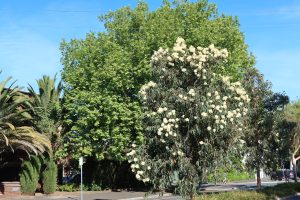
At the end of our street, we must stop before turning left or right. This week at that stop we come face to face with the extravagant blooms of Corymbia eximia. The tree, known as a common bloodwood, has tough tesselated yellow brown bark. They are native to New South Wales where in their natural range they grow on shallow infertile soils on sandstone.
The trees were planted in the Liardet St median in Port Melbourne in 2019. They were explicitly chosen for being well adapted to the warmer climate anticipated in Melbourne in future. They are thriving – and in splendid full bloom now, in October.

As part of Birrarung Riverfest, I attended a walk with Vicky Shukuroglou introducing the Eucalypts of the Diamond Creek. Vicky encouraged us to attend to every part of the tree as vital information – the fallen leaves, their shape and colour, the bark, the number of flowers and seeds.
Vicky has been learning about eucalypts since she was a child, mostly through ever more sensitive observation. She has recently co-authored an accessible guide to the Eucalypts of Melbourne.
As we walked, her commentary made clear that each tree exists in a web of relationship and supports myriad other life forms. No tree is an island.
Vicky was critical of the approach of bringing in tree species from other parts of Australia in the name of climate adaptation. It subtracts the tree from the web of relationships with which it co-evolved. In her view, we have not begun to understand the complexity of these relationships and the implications of this approach.
Of course, the City of Port Phillip is home to eucalypts from all over Australia, including some of our most loved species, Lemon Scented Gums and Spotted gums. Vicky, like naturalist Gio Fitzpatrick, cannot overstate the importance of planting locally indigenous species with which we are, paradoxically, less familiar.
At the back of the book, she lists the eucalypts that would have grown in each of today’s local governments areas.
This is the list of Eucalypts that would have grown in Port Phillip before colonisation.
Eucalyptus camaldulensis River Red Gum, leucoxylon Yellow Gum, microcarpa Grey Box, ovata Swamp Gum, viminalis manna gum.
Researchers at the University of Melbourne have been using old maps to work out, sometimes quite precisely, where these tree species used to grow. Sometimes trees were used as survey markers in preparing land for sale and so they are marked on maps.
Since Fishermans Bend was largely Crown Land, this methodology is not readily applied there.
As the maps are further refined, and where conditions are appropriate, the researchers hope to re-introduce those tree species in their original location.
As we know from previous discussions about the urban forest, trees are only one component of a forest, and the researchers are gradually piecing together a picture of the likely compositon of Melbourne’s vegetation all those years ago.
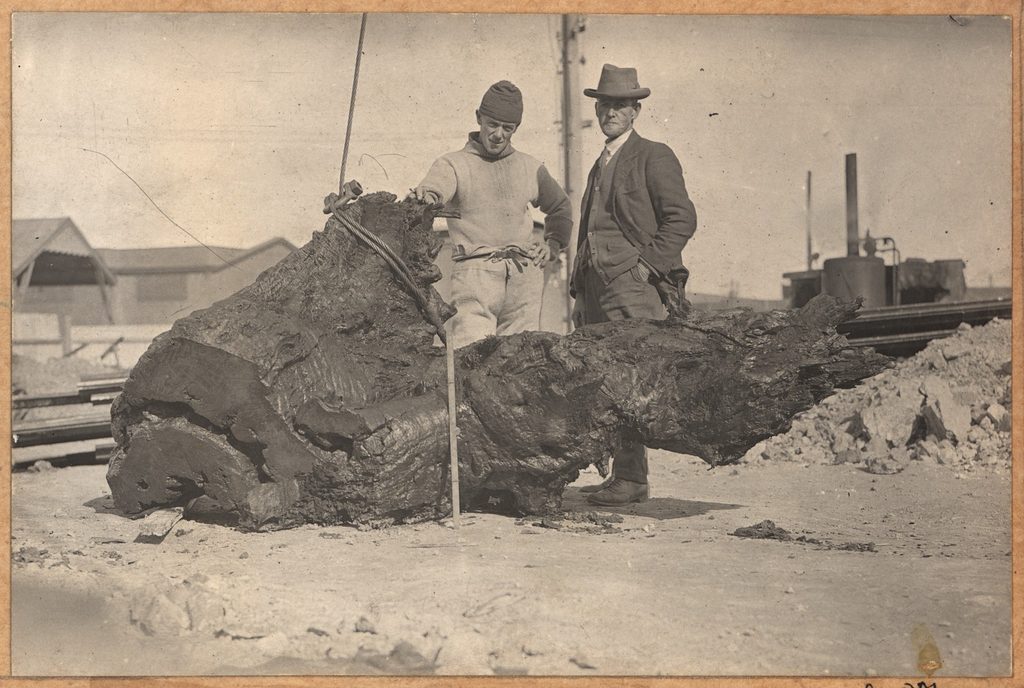
Ground conditions posed many challenges during the construction of the Spencer St Bridge in the 1920s. Near the Tea House engineers encountered a River Red Gum stump from a depth of 20m (63 feet). The wood was subsequently carbon-dated at 8800 years.
ACE Guide to Eucalypts Melbourne Vicky Shukuroglou and Rod Fensham
Professor Nicholas Williams and Associate Professor Amy Hahs Researchers have reconstructed Melbourne’s landscape 28 August 2026
Thank you to Fiona Campbell for bringing the story of the Red Gum stump to light.