
Montague
I was born in Boundary St 87 years ago. It was called Mon a gue then.
So said a man in casual conversation as we waited for take away coffees.
This post is about the area that was called Mon a gue back in the day. Not about the ward of Montague which will be represented by Alex Makin, the successful candidate at the 26 October Port Phillip local government election.
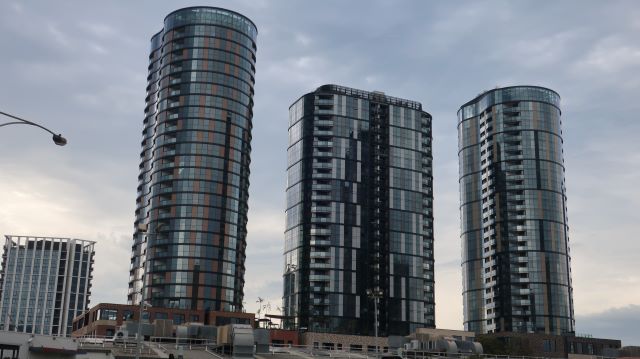
The Gladstone (15 – 85 Gladstone St) is complete. It consists of 700 apartments in three towers. It is a Build to rent (BTR) development. BTR means developers and their financiers build multi-unit buildings and, instead of selling the units, retain them to rent. The Gladstone is a project of Greystar, a global real estate company that specialises in the development, management and investment of rental housing.
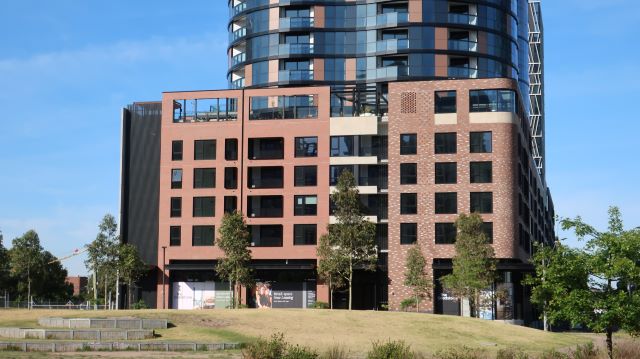
The planning history of this large site goes back more than a decade. In May 2013, shortly after Fishermans Bend was re-zoned to capital city zone, an application was made for four 38 storey towers containing 1023 apartments. A permit was issued in September 2014 with the towers reduced to 30 storeys. The site has bought and sold and re-designed a few times but that planning permit provided the approved footprint and framework for subsequent designs.
Each block of the Gladstone as built is differentiated from ground to podium level with different coloured bricks – 225,000 in all. This is intended to give a sense that the site is a collection on buildings at street level and to respond to the low buildings on the light rail side of Gladstone Street.
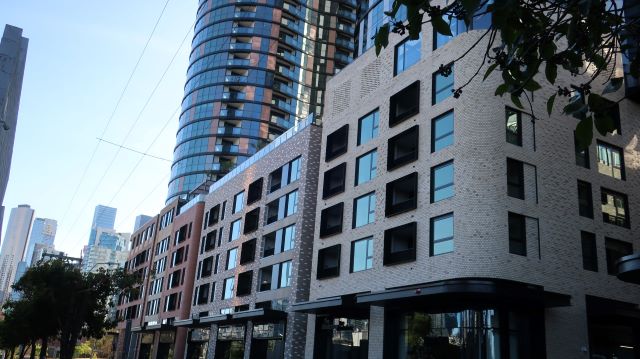
The Gladstone has generous common facilities, remote working areas, pools and outdoor spaces.
The ‘ground’ floor is elevated to allow for present and future flooding.
In any conversation about Fishermans Bend, people want to have confidence that community and transport infrastructure will be in place to support the livable communities promised in the Fishermans Bend Framework. That community infrastructure must be paid for.
Developers pay a contribution for each unit. Generally developers pay several different charges – an open space contribution, a waterways and drainage charge, and a development contribution (DCP). In addition, voluntary agreements to provide affordable housing as encouraged in the Fishermans Bend Framework are included in Section 173 agreements on a development by development basis.
Build to rent developments do not pay the open space contribution as they do not involve the subdivision of land.
Complex.
The government has put forward a proposal for a single new charge that combines all three charges. Submissions were heard by a Special Precincts Advisory Committee. Their report is due in February.
A strong case was made that Fishermans Bend warranted a separate governance authority since it is the largest urban renewal area in Australia. Its capital city zoning brings unequalled opportunities and many challenges. A dedicated governance authority, it was argued, would bring about an integrated approach to implementing plans for the area. Since then, the housing crisis has become ever more acute. Instead, Fishermans Bend has recently been declared a priority precinct along with Arden, Docklands, Footscray, East Werribee, Parkville and Sunshine.
More powers to deliver integrated transport and housing are proposed through the Transport Infrastructure and Planning Legislation Amendment Bill 2024 which is now before the Legislative Council.

Leave a Reply