

Practising democracy
It was barely light when the first voter staked her claim to the front of the queue. From 8.00 am when voting began, the queue lengthened from the South Melbourne Primary School entrance along Ferrars St towards City Road.
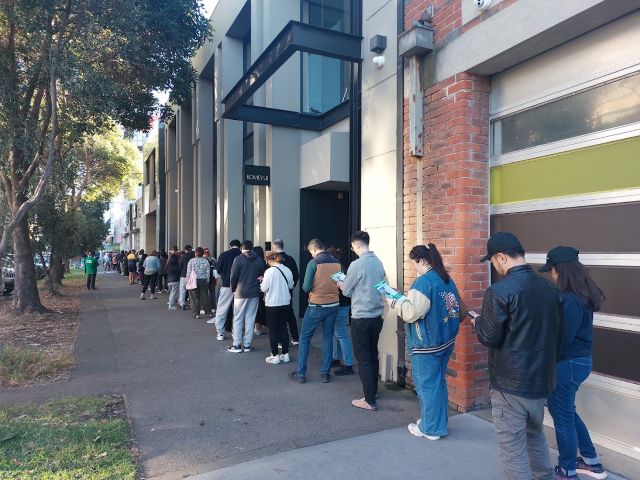
Even though so many had voted before the election, waiting times were nearly an hour throughout the day. The queue ebbed and flowed. Few people seemed visibly impatient. There was no democracy sausage for distraction. With the companionship of phones and headphones, the time passed. Most people declined how to vote material, politely gesturing towards their phones as the place where guidance was to be found.
The wall of the school lent its shoulder to lean on. The footpath was wide enough for voters, abundant A frames and party volunteers.
Deliberate courtesy and goodwill among volunteers prevailed. Greens supporters, mostly young, way outnumbered generally older Labor and Liberal volunteers.
Voters couldn’t take the option of driving to one of the quieter booths in Middle Park or Port Melbourne as most people had walked to the voting place. They were foot people, as urbanist Jane Jacobs would say.
Howard walked past on his way to the South Melbourne Market. I’d met him during Covid lockdown in Yarra’s Edge in Docklands when he jokingly challenged us for our passport. Since then, the confluence of our shared South Melbourne Market routine has led to further conversations, each building on the last.
City of Melbourne 2050 Summit
Less than a week later, in the afterglow of the optimism associated with a decisive Labor win, I was one of 700 citizens attending the Melbourne 2050 summit.
And I found myself randomly on a table with Howard!
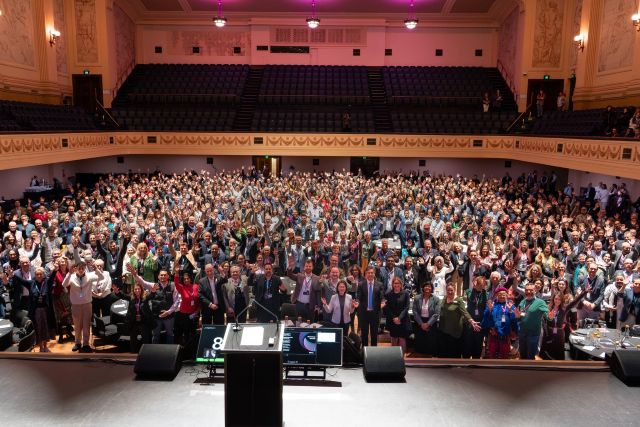
Given the centrality of Melbourne in the life of Victoria, the Governor, Her Excellency Professor the Honourable Margaret Gardner AC and Premier Jacinta Allen set the scene. It was no surprise that the Governor spoke to the importance of education, given her former role as Vice Chancellor of Monash University.
Lord Mayor Nick Reece reminded us of the the legacy of all the public institutions that have been part of Victoria since the earliest days: the State Library, the University of Melbourne and the MCG.
Tony Ellwood was persuasive that creativity is core infrastructure in Melbourne.
The City of Melbourne ensured that young voices were heard first. A Youth Summit convened the week before developed directions to guide the wider summit. These were powerfully conveyed by youth advocate and commentator Ahelee Rahman. The directions were printed out and present in all the subsequent thematic discussions.
First among the directions were for people to think and plan with hope and optimism.
It was hard to think about Melbourne 25 years from now. It helped to think of how the city has changed in the recent past. The first apartment development in Docklands started in 2000. The transformation of Port Melbourne, including Beacon Cove and the southern end of Bay St, date back to around 2000.
Fishermans Bend was only re-zoned in 2012. The school used as a polling place only opened in 2018. The Fishermans Bend Framework plan goes to 2050. Will it be like Docklands then? Or quite different?
Summit participants worked together in five different themes, with optimism and hope as directed, and goodwill towards the process.
Facilitating a process for 700 people is not easy. Careful preparation and well trained City of Melbourne staff ensured that the clumsy, awkward process of synthesising a collective statement to go forward to the whole summit was achieved.
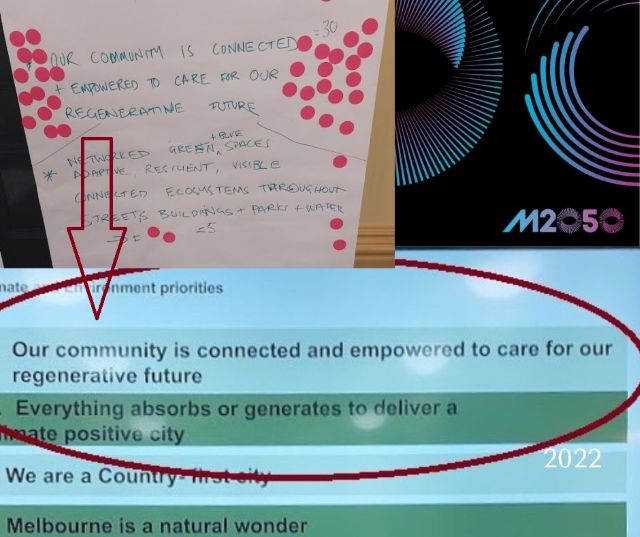
‘All motherhood statements’, said Howard. Yes, but an assertion of what those gathered value about Melbourne: its commitment to creativity, culture, education and sport, trees and parks, and to being inclusive and accessible.
When contributing to a process like the summit, or the election, it’s hard to see your fingerprint in the outcome. It can feel like a waste of time. An alternative view is that when you cast your thoughts into the pool of a collective process, they gather with other like thoughts, to become a bit like a snag in a river. The contribution is amplified. It grows stronger and takes on richer life.
Economist Richard Dennis says on repeat that ‘Democracy thrives on high expectations’. And, he might well have added, on participation.
It’s hard to walk around Port without being invited to have you say on the latest Port Phillip council policy or strategy. Colourful corflutes are strategically placed to catch our eye, and the QR code leads directly to the engagement page. More and more is being done to bring consultation closer to us, rather than, as used to be the practice, make us go to them.
And now the election is over, the patient queues can be for croissants and borek at the South Melbourne Market.
Janet Bolitho supported Josh Burns campaign in Macnamara

Leave a Reply