
The Cerberus and MARS 11
This is an edited version of one stop on the walk Piers & Politics, 23 February 2025.
Why is the statue Answering the Call here, in Port Melbourne?
Answering the Call commemorates and celebrates Port Melbourne’s deep connections with the navy. I say navy, because the Royal Australian Navy, formed in 1911, was preceded by the Victorian Colonial Navy with which Port had a very close association indeed.
The gold rich colony of Victoria lived in fear of invasion. During and after the Crimean War this apprehension reached fever pitch. Batteries lined the Sandridge foreshore.
The voluntary Sandridge Naval Brigade trained in Dow St and on Town Pier at the end of Bay St.
‘The Sandridge Corps of the Naval Brigade paraded on Friday at the drill room in Dow Street for official inspection. A hundred members were present … and the men went to quarters. The guns were all cast loose and run out, guns on both sides manned; broadside and independent firing was practised.’
There was a recognition that to defend itself, the colony of Victoria would need to move from forts and fortifications to armoured warships. It could not rely for its defence on the distant British Navy. The Colonial Naval Defence Act 1865 empowered the colonies to acquire warships and seamen to serve in them.
A warship was ordered to which Victoria contributed £25,000 and the British £100,000. The new warship, the Cerberus, was designed by Sir E J Reed, Chief Constructor of the Admiralty. He evolved the design of ironclad vessels used in the American Civil War to create a ship for the particular defence needs of Port Phillip Bay.
Cerberus was designed to be impenetrable to enemy fire but this made her ‘unweatherly, slow and awkward’. From stem to stern it was sheeted with iron armour up to 8 inches thick.
Captain Panter was sent to Britain to bring the Cerberus back from Jarrow on Tyne where it was built. The voyage took nearly 6 months in extremely difficult conditions. The ironclad warship was hard to steer. It listed badly. In severe storms encountered along the way, it was feared she would be lost.
Cerberus came out under a merchant flag with a merchant crew. Conditions were unbearable for the crew below decks stoking the engines with coal. They said they would rather go to prison and serve hard labour than continue on the Cerberus.
HMVS Cerberus finally arrived in Hobsons Bay around noon on Sunday 9 April 1871. News of its arrival spread rapidly.
‘There was a general rush to Sandridge’. Extra trains were put on. Boatmen did a roaring trade. The piers were crowded.
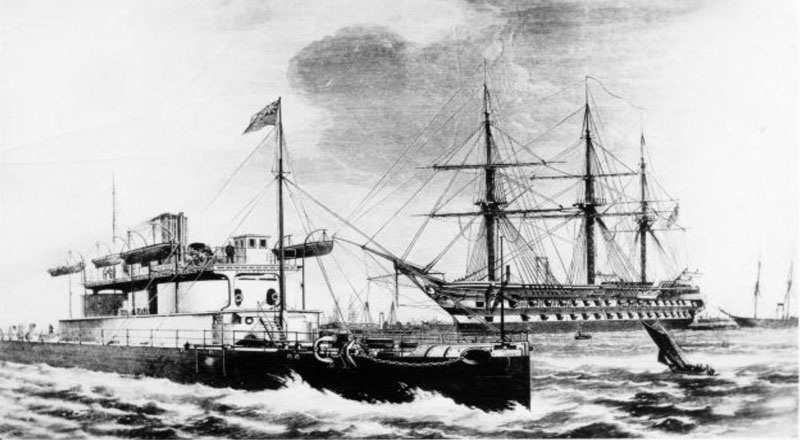
The impression of the ship was not altogether favourable. The Cerberus was described as ‘low uncouth and grim looking like a half tide rock in the water, like a floating gaswork’.
The Cerberus was capable of lowering itself in the water so that only the turrets were visible by flooding compartments between the outer and inner shells of the ship.
The Cerberus was used for naval training and exercises until 1924 when it was sold for scrap. The Sandringham Council bought the wreck which was towed from Williamstown and scuttled off shore at Half Moon Bay to form a breakwater.
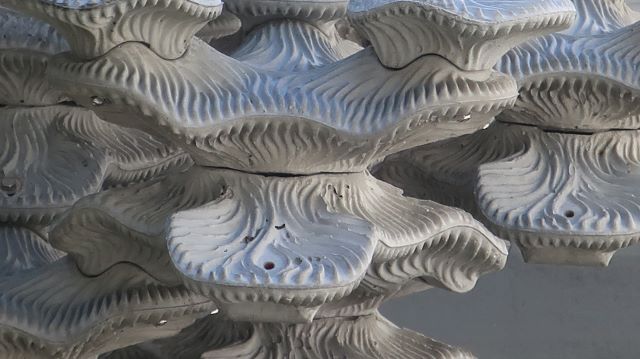
As a boy growing up in a Bayside suburb, Alex Goad was inspired by the marine life he saw growing on the Cerberus1 and other artificial structures.
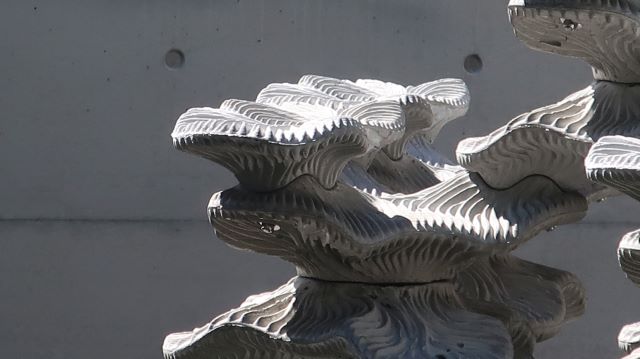
A sculptor and designer, Alex has created MARS 11 (Modular Artificial Reef Structures). He designs and fabricates the artificial reef structure from his studio in Mentone using a 3D printer. The structures are modular and interlock, a bit like lego. The lattice like structure makes them very strong.
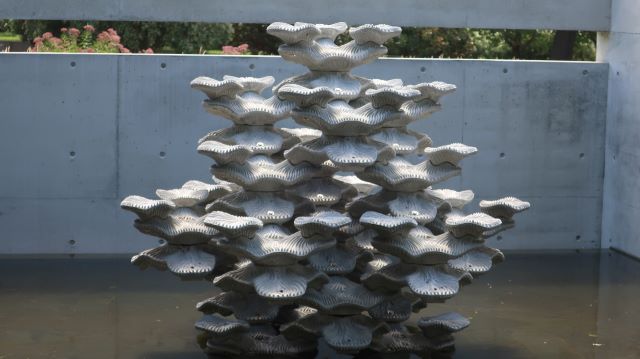
Alex strongly believes that beauty and aesthetics can go hand in hand in ecological repair.
The artificial reef structures are deployed in highly degraded marine environments where the substrate on which marine organisms grow has been destroyed.
it is important to Alex that the reefs can be installed without massive barges and expensive marine equipment. At some sites, the moulds have filled with concrete on the beach and then installed off shore. This makes them more affordable for countries with small budgets.
The artificial reef structures mimic the complex structures and surfaces that natural reefs provide. Marine organisms don’t readily adhere to smooth surfaces, Furthermore, on large exposed smooth surfaces they are more vulnerable to predation. The crevices, nooks and crannies give them somewhere to live way from harm.
The artificial reefs are quickly colonised by marine organisms. Alex loves watching these underwater gardens come to life. They are fantastic places to snorkel without risking any harm to natural reef structures.
Kate Orff is also working on living breakwaters in the US. She writes: ‘We’re in a moment of crisis, and it’s not enough to just make beautiful landscapes. We have to fix them too.’2
Read more
1 Note that there is now an exclusion zone around Cerberus and access to it is not permitted
2 Kate Orff quoted in The New Yorker 9 August 2021
Reef Design Lab Artificial Reefs and Marine Infrastructure Solutions
Friends of the Cerberus for every detail about the Cerberus and the journey to Australia
Colin Jones Australian Colonial Navies 1986

Leave a Reply