
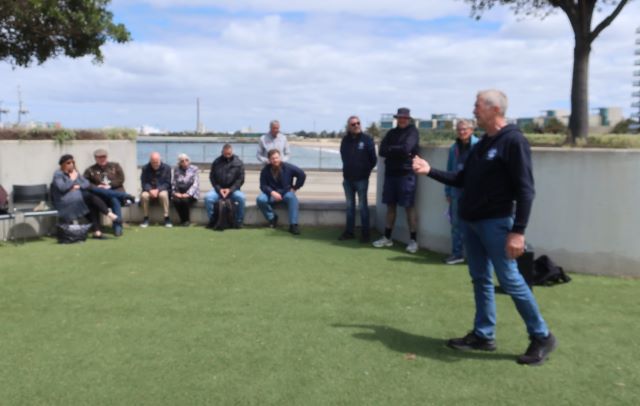
Commemoration at Princes Pier
People gathered at Princes Pier to commemorate the life of Allan Whittaker, waterside worker, who was shot by police at Princes Pier in a bitter waterfront dispute on 2 November 1928. He died on 26 January 1929.
This post is a re-working of the speech I made at the commemoration.
This is the twentieth annual commemoration of the life of Allan Whittaker and the circumstances surrounding his shooting.
There are several elements to this commemoration. It is repeated annually at the place where the events unfolded. The story gets told and re-told in place.
Here.
Layer is added to layer.
Even though Princes Pier is completely transformed from how it was in 1928, nevertheless, and especially on a cold and windy day, it gives a glimmer of how bleak conditions were on the Pier back then. Being in place stimulates the historical imagination.
Allan Whittaker embarked for service in World War 1 here, on the HMAT Afric. Shot in the foot on the very first day of the Anzac Day landing at Gallipoli, he returned to Australia, here, on the Hororata.
At the time of the waterfront dispute, he lived in the area – around Thistlethwaite and Crockford St. He was a local.
Time
A powerful element of a commemoration is being held on (more or less) the same day, and time, each year. The familiar story is retold in relation to contemporary events.
This commemoration is held in the context of local, national and global events. War in the Middle East and Urkraine, the imminent US Presidential election and escalating tension in our region. And in Australia, cost of living pressures, growing inequality and rising homelessness.
Now, as in 1928, people are having to turn to charities for food and shelter.
Shipping, then as now, connects the local to the global – Port Melbourne to the world.
Today, Disney’s cruise ship Wonder is at Station Pier. In 1928, P & O’s Chitral was at Princes Pier.
Why is it important to tell Whittaker’s story?
Perce White1 told me there were things I needed to know if I was to represent Port Melbourne.
One day, he told me he would pick me up as there was something he wanted to show me. It was the opening of a mural on Central Pier in Docklands of a waterside worker in the hold of a ship shovelling asbestos. No protective clothing. Just a singlet.
Telling Allan Whittaker’s story was hugely important to Perce. Now he has died, as have several other custodians of this story, the Historical Society is making a short film about Whittaker to ensure the story lives on.
In an interview for the film, former Supreme Court judge Frank Vincent, who grew up in Port Melbourne, explained that in that dispute on the pier, Allan Whittaker was not leading the union charge, nor was there any suggestion that he was acting aggressively in any way. Rather, Whittaker was trailing at the back of the crowd, trying to get away. By all accounts he was a gaunt, war weary man with a limp who fell victim to the careless and impetuous action of Inspector Mossop who fired the shot.
As Frank Vincent has related many times, it is likely that Whittaker’s death was as much attributable to malnutrition, as to his wounds.
Vincent said that the relevance of Whittaker’s story lies in its being a very ordinary story. ‘The power of the story comes from his ordinariness. We would never have known about him apart from the fact that he was killed in those circumstances.’
Extreme casualisation was an issue in that dispute in 1928 with workers having to wait to be selected, often in vain, for menial, back breaking work.
Our contemporary challenges are both different and similar. Casualisation takes different forms.
Remembering Allan Whittaker is a call to remember those ‘ordinary’ people as well as the role unions played in securing better conditions for workers on the waterfront.
Post event reflection
Speakers recalled the depth of bitterness between union and ‘casual’ labour in 1928. Scabs ‘took the bread out of our families’ mouths’. That bitterness was passed on, and persisted into the next generation.
The union movement is rent with division following the Albanese government’s action in appointing an administrator to the construction branch of the CFMEU. The CFMEU has voted to split from the ACTU. The CFMEU’s support for the Labor Party is no longer assured.
What will this fracture and fragmentation mean? And will it be as enduringly bitter as those divisions in waterfront communities in the 1930s?
No mention of the angry confrontation at Princes Pier in the shipping news. Instead, it was reported that the P & O Chitral would delay her departure from 12 00 to 6 pm the following Tuesday so that passengers could watch the Melbourne Cup.
These lines from Seamus Heaney’s poem Mint, written in conflict ridden Northern Ireland, came back to me
‘Like the disregarded ones we turned against
Because we’d failed them by our disregard.’
1 Perce White, who died in 2022 , was many times the Mayor of Port Melbourne and a former waterside worker.
Access Frank Vincent’s speeches at previous commemorations at the Port Melbourne Historical and Preservation Society website by searching ‘Allan Whittaker’

Leave a Reply