
Renewal at Gasworks Park
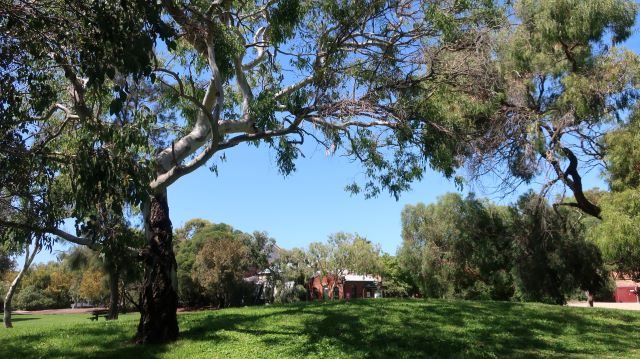
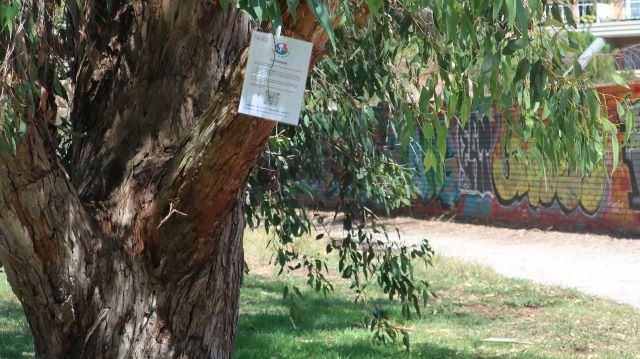
Notices on 63 trees and shrubs around the perimeter of Gasworks Park advise of their imminent removal for the second stage of the Gasworks Park upgrade. The first stage was the children’s playground, opened late in 2024.
The upgrade has been incubating for more than a decade. The first investigations of the underlying site conditions were prompted by South Port Community Residential Home’s exploration of upgrading their facility. The initial recommendation to cap the whole site, which would have required the removal of all the trees, was passionately opposed by the community. It would also have been massively expensive.
The gasworks plant was de-commissioned in 1955. Discussion about using the site for community purposes began in the 1970s. In 1975 the State Government agreed to buy two-thirds of the site for open space. The remaining third was purchased by the City of South Melbourne. Many ideas were put forward for that third. The strongest support from the communities of South and Port was the South Port Community Residential Home which opened before plans for the remainder of the Park were resolved.
The evolution of Gasworks into an arts village in 1986 is told in Robert Grogan’s book Gasworks to Gasworks1. Several eminent Melbourne artists including Jan Senbergs, Bruce Armstrong and Anton Hassell were early advocates for an arts led renewal of the former Gasworks.
The site was turfed and landscaped but no remediation was done at that time.
The various site investigations include fascinating insights into the layers of the geological history of Gasworks. Under the grassy surface is unevenly distributed fill of old Gasworks rubble. Below that lie the Port Melbourne sands, consisting of raised beach ridges or well sorted sand, shelly sand, minor silty or clayey sand or Brighton Group sediments comprising sequences of soil, sand and clays.
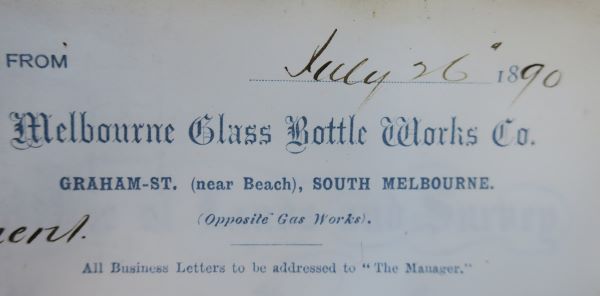
It was those Port Melbourne sands that attracted Felton Grimwade & Co to establish the Melbourne Glass Bottle Works opposite Gasworks in 1872 to make bottles for the pharmaceutical products manufactured at nearby Ingles St.
Over the period that the park upgrade has been under discussion, and with uncertainty about future environmental management requirements, there has been minimal investment in the landscape. Many of the trees marked for removal have been looking poorly for some time, their canopies thinning. Removal of the many scrappy shrubs won’t be mourned. The fruit trees near the cafe to be removed are a legacy from the 1980s when the deeply degraded site invited an imaginative response of care. Nowadays, people would be more likely to understand the risk of planting fruit trees in highly contaminated land.
The public sculpture The Angel by Sione Francis was the gift of then Mayor of South Melbourne, Frank o’Connor to Gasworks. As part of the upgrade, the area under the watchful Angel will become another performance space, flanked by the palm trees which have been removed from the gravel area near the entrance and wait in readiness near the Sculpture Studio to be re-planted.
In spite of our love for the park’s bush like character, it does not support a great variety of birds of different species. Rob Youl and Gasworks friends have conducted bird surveys at Gasworks over many years which show that the most abundant birds are rainbow lorikeets and noisy miners. The current structure of the vegetation – large open areas with tall trees – supports noisy miners over small birds.
Friends of Gasworks have asked for a stay of execution on some of the larger trees, arguing that they will provide shade and canopy for some years yet. There’s no doubt that for a time when the trees are gone the Park will look quite stark. There’ll be a feeling of loss, a different quality to the light. The now shady path will be brighter.
This time will be followed by the planting of 300 trees and 3,500 mostly indigenous plants. The focus will be on shallow rooted plants that will not penetrate into the legacy Gasworks infrastructure below. Gasworks will connect up with the Danks St biolink and Lagoon Reserve – patches in the urban fabric supporting the movement of insects and birds.
The ongoing environmental management plan will require that grassy cover is maintained.
This is the biggest change to Gasworks Park since that first transformation in the 1980s.
It’s a generational change.
More
Documentation on the Gasworks Park upgrade is on the City of Port Phillip’s Gasworks Arts Park overall site upgrade page.
To find out more the transformation of Gasworks in the late 1980s, I recommend Robert Grogan’s history of Gasworks to Gasworks From an industrial complex to an arts park is available on the Gasworks website
Note: the trees marked for removal were so removed in early March 2025
2 Comments
-
Joan Heath
Thank you for putting us in the picture - it’s great to have such accessible information about the progress of the Gasworks grand plan. Clearly lots of thought has been gone into this. It will be interesting to watch it all unfold.


Rhonda Small
Very helpful overview of Gasworks Park history and future. Thank you!