
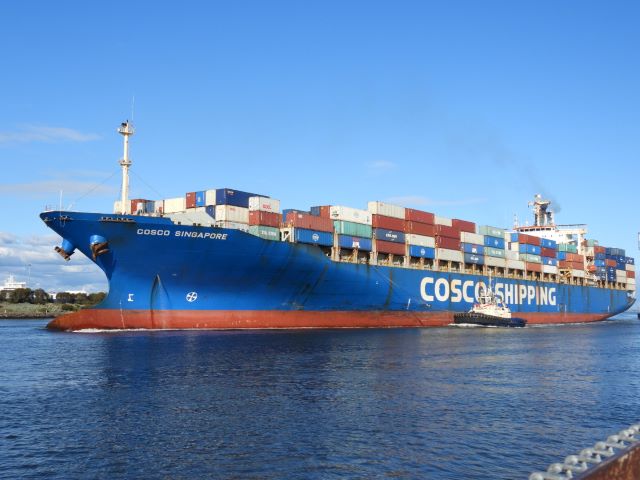
World shipping
This week delegates of the Marine Environment Protection Committee (MPEC) of the International Maritime Organisaton (IMO) have been meeting in London.
The negotiations are about developing a proposal to give effect to the IMO’s 2023 commitment ‘to peak GHG emissions from international shipping as soon as possible and to reach net-zero GHG emissions by or around, i.e. close to, 2050, taking into account different national circumstances, whilst pursuing efforts towards phasing them out as called for in the Vision consistent with the long-term temperature goal set out in Article 2 of the Paris Agreement’.
MEPC delegates have been debating whether to tax shipping emissions through a fuel standard (a carbon credits trading scheme) or a universal levy (a flat-rate tax on emissions).
Some such mechanism is needed to incentivise the take-up and development of low and zero carbon fuels which are way more expensive than fossil fuels, as well as to support developing countries with the transition.
The US delegaton has been notable by its absence. At the 11th hour, a letter was received from US President Donald Trump. He called on the United Nations to ‘halt all efforts to proliferate the deeply unfair agenda reflected in the Paris Agreement in other fora.’
This late intervention puts at risk the emerging, and tentative concensus that was emerging among member nations, giving reluctant nations a reason not to commit.
The negotiations conclude today, April 11th.
Even before ‘Liberaton Day’ on 2 April, President Trump had announced measures against Chinese shipping and his intention to build a strong US ship building industry.
He proposed port fees of $1.5 million on Chinese built vessels, and $1 million on fleets that contain Chinese built vessels, or ships on order from Chinese ship building yards.
The World Shipping Council argued that the fees would lead to port congestion as ships would be disinclined to call at smaller ports on account of the prohibitive port fees.
As of early 2023, Chinese shipyards had orders for 1,794 large commercial vessels. This surpasses (by far) the combined orders of South Korea (734) and Japan (587). To put it in context, the United States had only 5 such orders.1
There is a mighty gap to close. The US is also short of mariners.
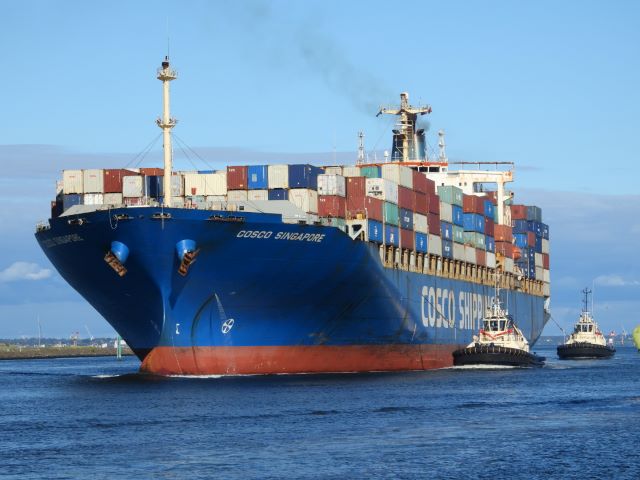
Port fees will affect companies like Chinese state-owned COSCO, a multinational marine transportation service conglomerate, headquartered in Shanghai.
America accelerated ship building in the latter years of World War 11.
The first vessel launched, SS United Victory, was built by Kaiser’s Oregon Shipbuilding Corporation, near Portland, and delivered on February 28, 1944. The Victory ships were built with astonishing speed. By the end of the war, the United States Maritime Commission had constructed a total of 531 ships.
Some of the Victory Ships built by the Maritime Commission were named for colleges and universities of the United States, including the Wooster Victory.
The SS Wooster Victory was constructed at the Bethlehem Fairfield Shipyards in Baltimore and launched on 25 April 1945. After the war, the Victory ships were used to take troops back to the US. Some, like the Wooster Victory, later became immigrant ships.
SS Wooster Victory was acquired by the Sitmar Line and re-named SS Castel Verde in 1953.
The Castel Verde brought displaced persons from Germany, Hungary, Russia, Ukraine, Latvia, Poland, Czechoslovakia, Romania to Australia after the war.
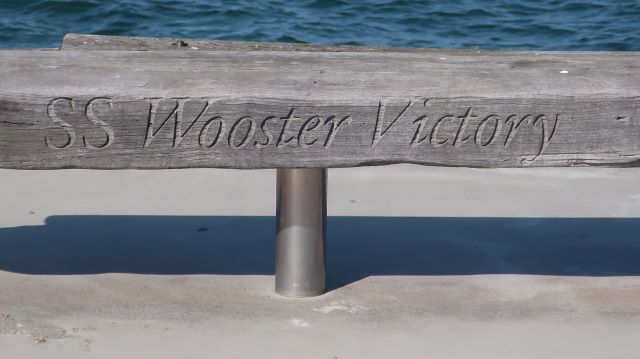
A bench on Princes Pier commemorates the SS Wooster Victory.
1 Virtue Marine Services Top ten ship building countries in the world
2 The Paris agreement was between nation states. Shipping was not included. Read Future Shipping.

John Milne
Very interesting Janet, at first I misread Cosco for Costco , & thought : Gee, I didn't realise it was involved in Shipping as Well. Re the Correa reflaxa, very like a Fuschia, but it is not??