
World trade and tapestries
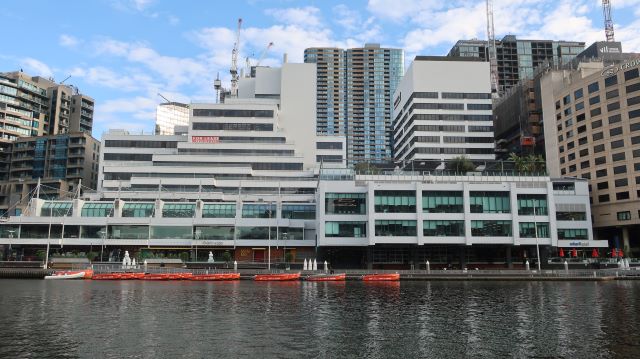
On a sunny day in 1983, delegates from around the world sat beneath the fluttering flags of many nations. They were assembled for the opening of Melbourne’s World Trade Centre.
The World Trade Centre movement was strongly identified with Guy F Tozzoli. He was hired in 1962 by the Port Authority of New York to head the development, construction and management of the World Trade Center, aimed at revitalising lower Manhattan.
The twin towers were destroyed in the terrorist attack on September 11, 2001.
Tozzoli was a dedicated advocate for the formation of World Trade Centres around the world to promote peace and prosperity through international trade. He remained President of the World Trade Centers Association until 2011, just two years before his death in 2013.
Melbourne’s World Trade Centre
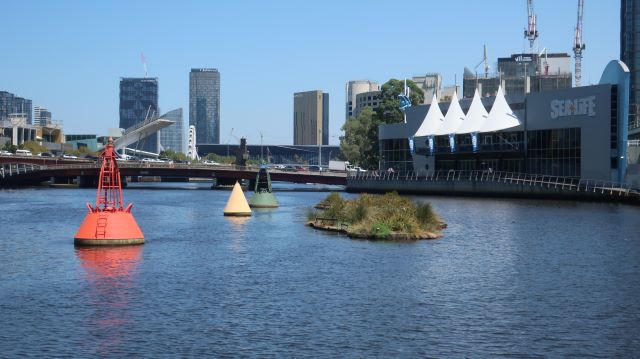
Swanson Dock, Melbourne’s first container terminal, opened in 1969. The opening of the Charles Grimes Bridge in 1978 cut off access to the River wharves which were, in any case, not suited to containers. Redundant Port land was now available for other purposes. A World Trade Centre would play a role in opening up central city Melbourne to the west, outside the Hoddle grid.
In 1978, the Melbourne Harbour Trust became the Port of Melbourne Authority, bringing it into line with other ports around the world. The same legislation that changed the name gave the port enabling powers to build a World Trade Centre.
The World Trade Centre would express the optimism of this period and the promise of building international cooperation through trade.
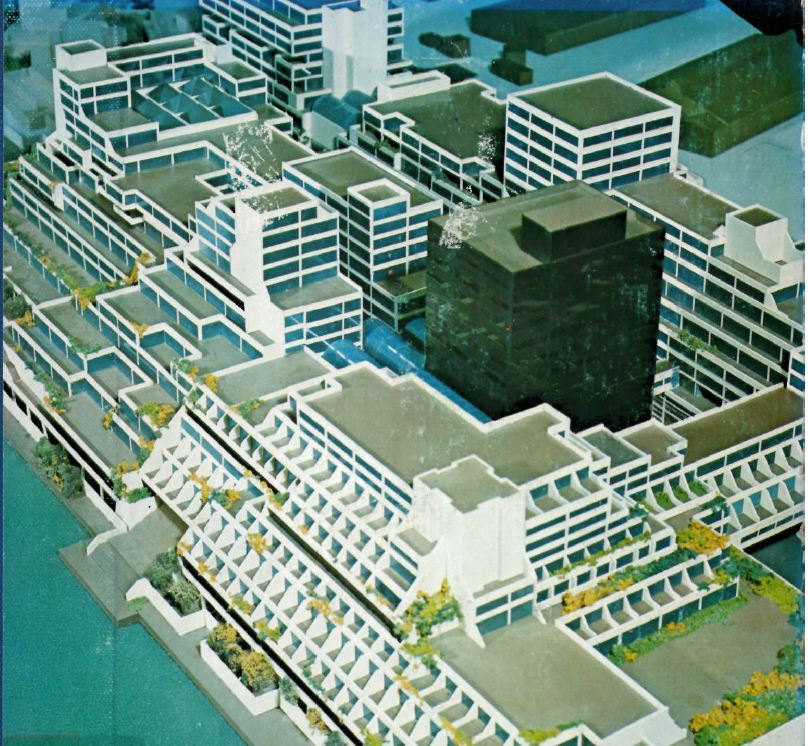
Architect Grahame Shaw’s design was chosen for the new Centre. Shaw had previously been in a practice with Bill Corker and John Denton, who were later (with Barrie Marshall) to design the Melbourne Convention and Exhibition Centre directly opposite. The WTC featured extensive exhibition spaces as well as offices. The Port of Melbourne Authority was also to be housed in the new building.
Premier Dick Hamer drove the first pile of the World Trade Centre development in March 1979.
I came across a copy of the speech he delivered on the occasion at the Public Record Office, annotated, in his hand, for emphasis
“It is a bold move I
it is a well timed move I
it is a well researched move”
The WTC opened in 1983 with a newly elected Labor government led by Premier John Cain in office.
Victorian Tapestry Workshop
Founding Director of the Victorian Tapestry Workshop, Sue Walker, learned that there were 24 tapestries on display in the World Trade Centre in New York. She saw an opportunity for the newly established Victorian Tapestry Workshop in South Melbourne.
Architect Graham Shaw visited the workshop in South Melbourne several times, later accompanied by the manager of the WTC.
Two tapestries were commissioned, designed by artists Murray Walker and Mike Brown.
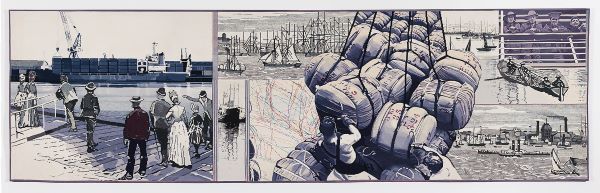
Murray Walker’s Port Reflections was a black and white drawing revealing the history and evolution of the Port. The work was interpreted by weaver Sara Lindsay with the skill and sensitivity for which the (now) Australian Tapestry Workshop is renowned.
Mike Brown designed Port Impressions. He was the workshop’s second artist in residence in 1982. Brown was described by Charles Nodrum as ‘an artistic anarchist and polemicist . . . he waged an unwavering war on art world conventions and sensibilities, critiquing mass culture, consumerism, sex, advertising, censorship, and embracing counterculture’.
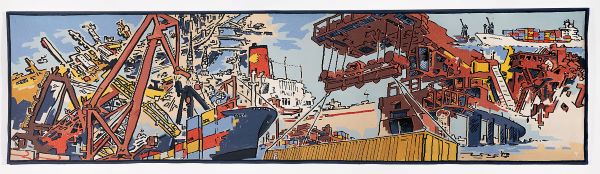
The commissioning was fraught with different preferences for the two styles and approaches – Walker’s more traditional, and Brown’s abstract and ‘visually challenging design’.
The tapestries were cut off the loom by then chairman of the Port of Melbourne Authority, A. S. Maye in September, well in time for the assembly of delegates from World Trade Centres around the world in November 1983.
Australian Tapestry Workshop
The tapestry currently on the loom at the ATW is Welcome to Country – now you see me: seeing the invisible created by renowned artist Maree Clarke (Yorta Yorta/Wamba Wamba/Mutti Mutti/Boonwurrung) with Mitch Mahoney (Boonwurrung/Barkindji).
The tapestry will hang in the new Footscray Hospital due for completion in late 2025. Director of the ATW Sophie Travers says ‘The tapestries we have woven for hospitals are amongst our most loved, because of the colour, warmth, and connection they bring to people of all backgrounds’.
Welcome to Country incorporates microscopic images of river reeds from the Maribyrnong River and skeletal drawings of local native flora and fauna.
The tapestry will take a team of 10 weavers around 12 months to create. The weaving team will draw from the ATW’s extensive palette of over 360 coloured yarns sourced from Victorian farms and dyed on site in South Melbourne.
And you can drop in whenever the ATW is open, and watch the weavers at work.
More
The tapestries were/are on display in the Welcome Hall at Station Pier.
Sue Walker, Artists Tapestries from Australia 1976 to 2005
Welcome to Country Australian Tapestry Workshop.
Grahame Shaw 1928 to 1985
4 Comments
-
Judy
Thank you for this inspiring and optimistic approach. I very much appreciate being introduced to the breadth of Maree Clarke’s work
-
Anne Garrow
Thank you Janet. Very interesting and causes one to reflect on and appreciate the energy of visionaries and the depth of skills of artists. Are the two tapestries Port Reflections and Port Impressions still able to be viewed at the WTC or elsewhere?
-
Hi Anne, I think the tapestries are still hanging in the Welcome Hall at Station Pier, but the post is a prompt to check.
-


John Milne
Excellent story Janet.👋👋