
Greening the Sandridge foreshore
Port Phillip Council is inviting feedback on its plans to plant more trees at Fred Jackson Reserve and the Sandridge foreshore.
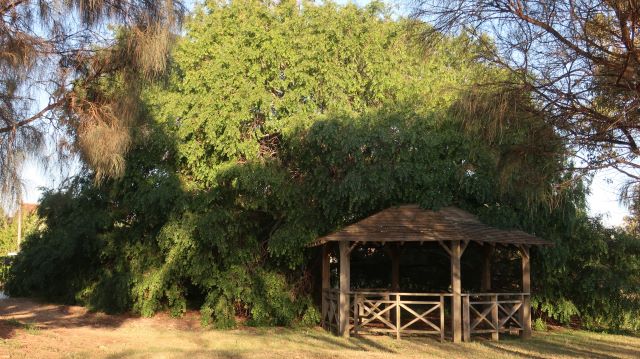
Fred Jackson was the Town Clerk of Port Melbourne from 1973 to 1988. He loved flowering gums, and a deep red specimen was planted in his memory, along with a small plaque. The deteriorating rotunda looks like it dates from that time when this interestingly configured piece of open space was named Fred Jackson Reserve.
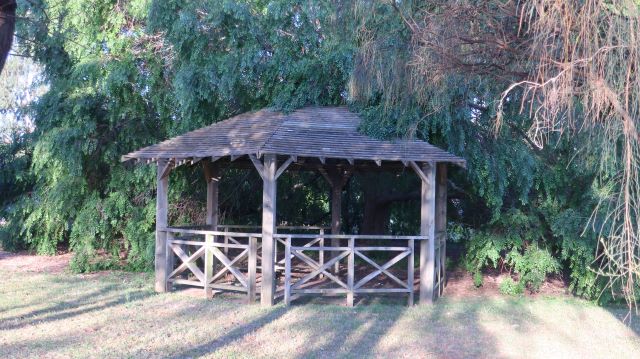
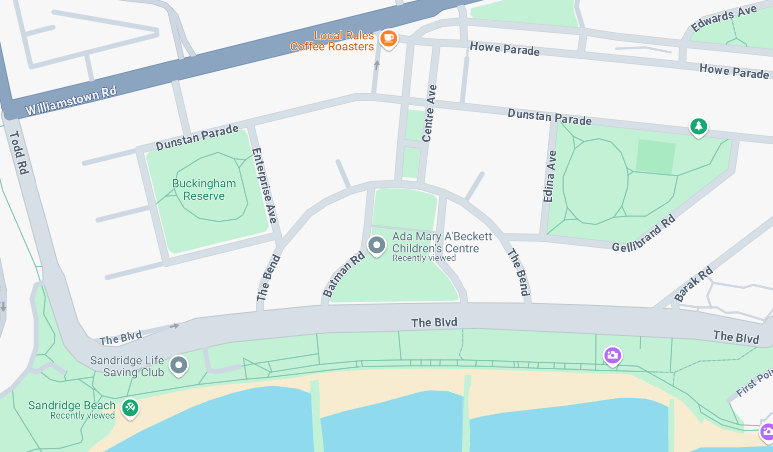
The building occupied by Ada Mary a Beckett children’s centre was also built at this time. Perhaps the magnificent Chinese elm was planted too?
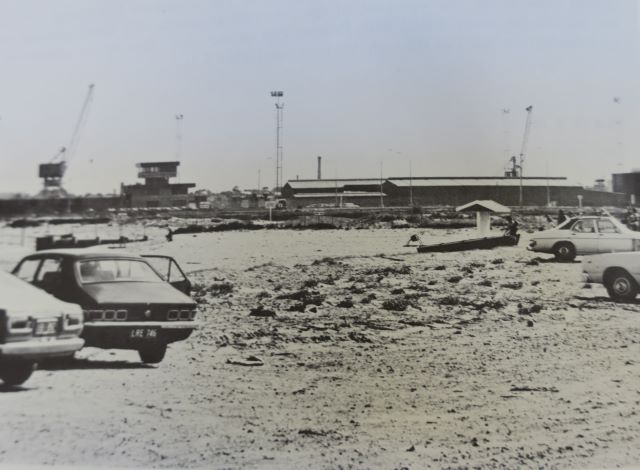
When the Fishermans Bend estate was built from 1938 onwards the place was devoid of trees as this photograph shows.
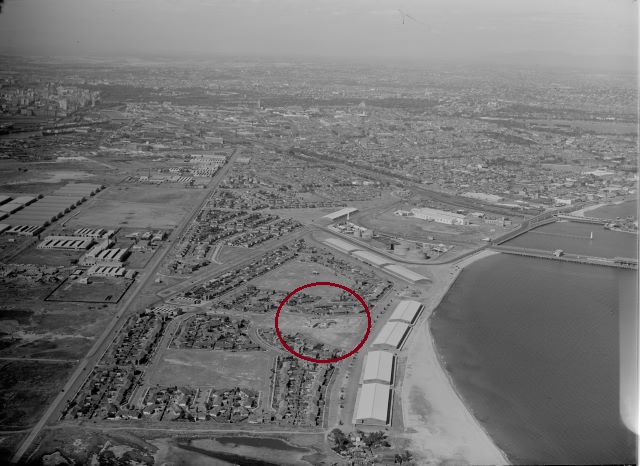
The first estate of the new Housing Commissions of Victoria was built to a prize winning scheme by town planner Saxil Tuxen. Centre Avenue marked the two parts of the estate, with the area now known as Fred Jackson Reserve earmarked for ambitious community facilities. Only a modest Ada Mary a Beckett kindergarten was built.
Sandridge foreshore
The Sandridge foreshore stretches from First Point at Beacon Cove to Todd Rd. A wide strip of landscaping separates Sandridge beach from The Boulevard.
During the second world war, storage sheds to supply American vessels at the piers were erected along the foreshore. The sheds deteriorated over time and were demolished.
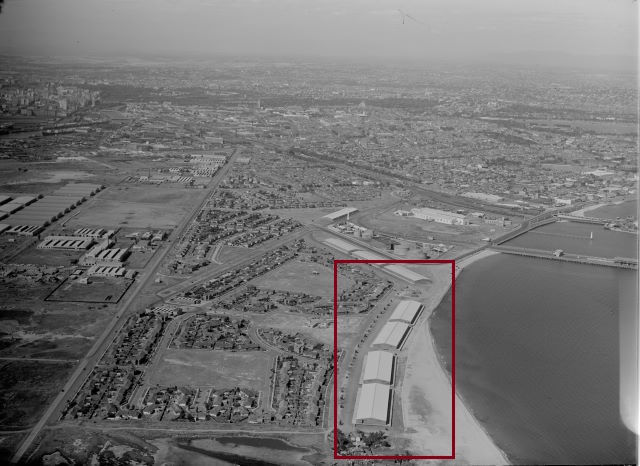
In the 1970s, the Port sought to resolve the conundrum of connecting an expanding Webb Dock with the rail network at Princes Pier. The first proposal, to put a railway line down Howe Parade, was fiercely opposed by local people and withdrawn.
It was back to the drawing board. An alternative route was proposed – a rail line along that spacious foreshore. That didn’t go down well either.
Meanwhile, the City of Port Melbourne, in concert with its engaged citizens, took action in a community guerilla planting of the Sandridge foreshore with native vegetation. This established the foundation of the foreshore’s landscape character. The Boulevard route was also abandoned.
When groynes were put in to secure the new Sandridge beach and replace the failing bluestone steps, another layer of plants were added. And so it has continued.
That early landscape was not designed intentionally but it has established a character of Coast banksia, Banksia integrifolia, she oak Allocasaurina verticillata as well as tea tree that are becoming more sculptural as they age – an approximation of Coast Banksia woodland.
The tree planting along the Sandridge foreshore implements the City of Port Phillip’s Urban Forest Strategy, adopted earlier this year.
Growing the urban forest should go hand in hand with supporting biodiversity argues naturalist Gio Fitzpatrick. He makes a very strong case for using locally indigenous trees in the urban forest.
Part of the intention of this planting scheme is to encourage small birds including the superb fairy wren. That intention is a marker of their absence.
It is interesting to note in Practical Ecology’s 2015 report for the City of Port Phillip that ‘superb fairy-wrens were consistently observed foraging at Sandridge Foreshore’1.
In contributing feedback on the planting plan, I will be submitting that the Council continue to reinforce the Coast Banksia woodland character of the Sandridge foreshore, rather than introducing eucalypts from other parts of Australia.
1City of Port Phillip Foreshore and Hinterland Vegetation Management Plan
Management Plan, Practical Ecology, June 2015 p23
Frankston City Council EVC 002: Coast Banksia Woodland
History of Ada Mary A’Beckett Children’s Centre
Fred Jackson Reserve and the Sandridge foreshore
7 Comments
-
-
Thanks Kate. Yes Pat was my mentor in Port's history.
-
-
Heather Wheat
What a fascinating evolving area we live in. Love those beautiful bees.
-
Stephen Pennells
Walking back from Bili nursery carrying plants along the railway reserves and felt something... on wrist looking down at a blue banded 🐝!
-
That's fantastic Steve. I've yet to see one in my footpath garden but I'm hopeful that before too long, I too will report a sighting.
-
-
Deb Fisher
Thank you so much for writing about our interesting history , what a transformation! It would be wonderful to have the gorgeous superb wrens extend their habitat We are extremely supportive of the urban woodland habitat such a beautiful ecosystem
-
Let's create the conditions, and hopefully they will return.
-



Kate Thwaites
thank you Janet very interesting and always brings mind my neighbour Pat Grainger and her love of our suburbs history and stories Kate