
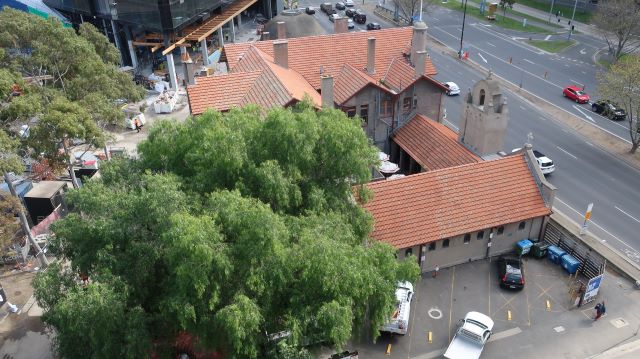
Melbourne Skyfarm
On top of a carpark next to the Mission to Seafarers is Melbourne Skyfarm. While it’s not yet open to the public, it’s super productive.

The 2,000 sq m urban farm is made up of modular Foodcubes. An earlier version of the Foodcube was trialled in in 2015 outside Holy Trinity in Bay St, Port Melbourne. The concept was further refined and then tested on two car parks in Rocklea Drive in Fishermans Bend.
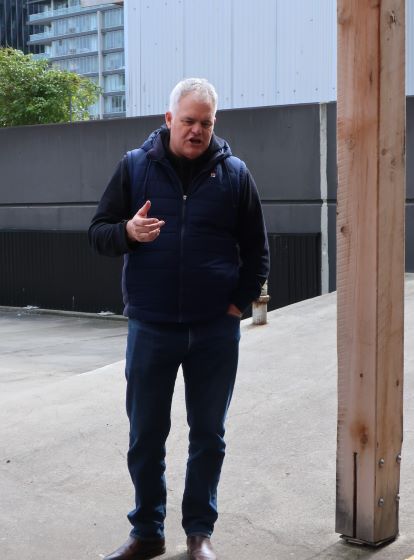
The Foodcube was developed by Brendan Condon and Marc Noyce. Speaking at the opening of the mini-farm in Bay St in 2015, Brendan spoke of the ‘megachallenges that are coming at us like a freight train’ – of climate change, biodiversity loss, water and food security. He devises solutions. Brendan’s approach is to develop a prototype and then scale up.
The Foodcube is made of 80% foodgrade recycled plastic. Foodcube uses a highly water efficient wicking system. Water is held in a reservoir at the bottom of the Foodcube and ‘wicked’ up by the roots of the plant. The gardener has only to check and replenish the water reservoir as required. The modular arrangement lends itself to the grid of the the carpark or any other flat concrete surface.
The Foodcube enables ‘food metres, rather than food miles’. The design of the Foodcube responds to the busy and demanding lives many people lead. Anything that might be a barrier to using the Foodcube has been addressed and overcome.
Cost of living pressures have made fresh food unaffordable for many people. That is why Melbourne Skyfarm has entered into a charity partnership with OzHarvest, based in Bertie St, Port Melbourne. To date, SkyFarm has donated over $100,000 worth of produce to OzHarvest. Each harvest from the Skyfarm is weighed and compared to supermarket prices to arrive at this figure.
The Foodcube is self contained, just perching on the concrete surface, so water sealing to protect the floors below is not required. That is a significant, and expensive, challenge in many roof top gardening projects.
Foodcubes can be linked together like Meccano. Extenders can be be easily added to grow taller plants. It’s hot and windy up there on the roof. Light screens have been attached that diffuse the wind.
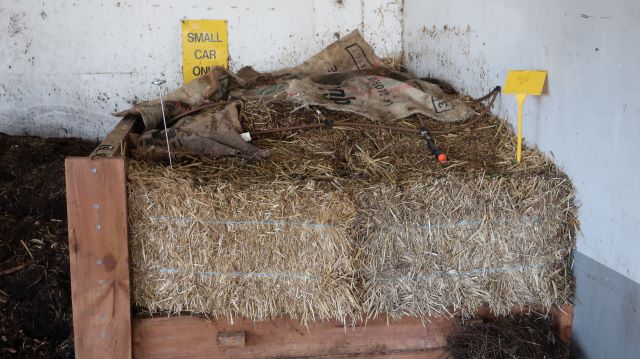
Urban farmer Andre Brokmerkel takes care of Melbourne Skyfarm. He is also using worms to create vermicompost to further enrich the soil. Two former carparks are given over to compost.
Foodcubes have been deployed in Pacific Island nations Tuvalu and Kiribati where salt water incursion due to sea level rise has made it difficult to grow crops. People in those nations increasingly rely on imported food which is expensive and not fresh. Because the Foodcube is sealed and raised from the ground, salt water is kept out, and precious fresh water used with maximum efficiency.
Foodcube has also been used in the community garden at the Walgett Aboriginal Health Service in western New South Wales where growing conditions are very difficult owing to high temperatures and water stress.
Follow up
Foodcube projects for an inspiring list of projects using Foodcube
2 Comments
-
-
Hi Linda Yes, those planter boxes are still in Turner St. They were trialling the use of recycled materials in those boxes, rather than using new materials each time, and then comparing their performance. The last I heard they were scaling up to a bigger version.
-


Linda N
What a fantastic initiative. Melbourne Uni post grad engineering students also developed a similar system for growing plants which they installed outside ARRB in Turner St Fishermans Bend a few years. I am not sure if the horticultural boxes are still there but they ran on a similar system that featured the wicking of water through plant roots and layered soil to provide necessary nutrients.