
‘More than just housing’
.The complexity and challenges of the housing crisis can feel overwhelming.
This week’s post highlights the work of a small housing organisation in Port Phillip ‘that could’ – South Port Community Housing Group, SPCHG.
The organisation is inseparable from the dedication of two of its founders: Beris Campbell, former Port Melbourne Council social worker and her South Melbourne counterpart, Heather McKee.
SPCHG’s focus is on single people at risk of homelessness. Starting with the management of two rooming houses in 1983, it now manages 350 individual tenancies.
Over the last forty years, rooming houses and boarding houses, once a feature of Port and South, have closed. Many have become single family homes. (I was about to say ‘reverted to’ but in fact several of these properties were boarding houses from the time they were built.) ‘Sleep outs’, once a feature of many Garden City homes, disappeared when houses changed hands. This process is ongoing with blocks of modest flats being replaced with single family homes.
It’s been a tough road for this small organisation. It has adapted and responded to the rapidly changing population profile in Port Phillip, and significant policy and regulatory changes affecting their work. Over time development projects have become more complex, require more capital, involve more risk. These changes have tended to favour bigger housing players. Their commitment to their purpose has never wavered. Over the years SPCHG has had to steadfastly assert the validity and value of their model – smaller projects catering to single people at risk of homelessness and an active tenancy management approach that supports community.
For over a decade, the tenacity of the organisation was sorely tested over a property in Emerald St, South Melbourne.
In 2014, SPCHG was approached by the G. W .Vowell Foundation wanting to sell their 31 bed-sit flats for the over 55 age group. The flats could have been lost to private development.
After an intense campaign, SPCHG obtained a State grant, borrowed funds for the first time, and purchased the Emerald Street property
They drew up plans to increase the number of dwellings. The intensification met neighbourhood opposition. A planning permit was finally secured for 41 dwellings.
Tenants were re-located. Negotiations with the State Government over funding the project were protracted. The dwellings deteriorated. It was painful to witness since the need for the housing was so urgent.
The Annual Report 2021/2022 notes ‘The Board and staff have given their all to building new social housing at our Emerald St site. Unfortunately, it appears that due to cost escalations and delay, the project, to build 41 new high quality social housing units in the heart of South Melbourne, is no longer certain to proceed.’
But SPCHG never gives up.
Instead, in partnership with Housing All Australians (HAA), the units were re-furbished. HAA brought together a team of builders, architects, surveyors, landscapers, students and other businesses to do the work. Their combined pro bono contribution was valued at $700,00.
HAA’s founder Robert Pradolin argues tirelessly that affordable, secure housing for all Australians is in everyone’s interest as well as in the interests of the economy, rather than approaching housing as a ‘welfare’ issue . Housing All Australians looks for solutions, and for solutions to which businesses and individuals can contribute, rather than standing by helplessly.
In April, 29 tenants moved in to the re-furbished Emerald St.
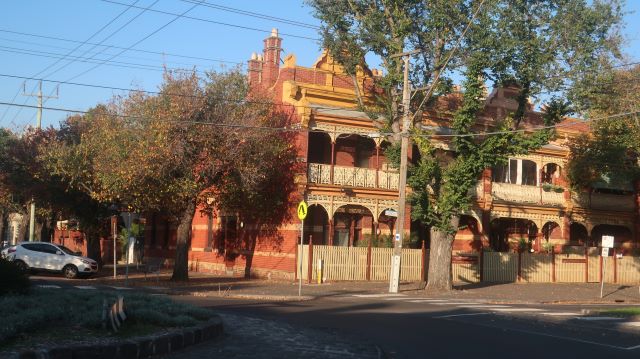
Many of SPCGH’s properties are heritage buildings in familiar streetscapes in South and Port.
SPCHG’s story has been able to be told through its care of its minutes and its record keeping. More than just housing brings together the rich recall of its founders, Beris Campbell and Heather McKee, the life stories of tenants and the contribution of long standing staff.
Under the leadership of then Mayor, Tim Costello, the former City of St Kilda identified the need to invest in affordable housing. It was needed to enable people who had lived in St Kilda all their lives to stay close to their community and services as the suburb became less affordable. The City of Port Phillip continued that commitment. For decades it was a leader in local government in social housing, putting money aside in each budget to grow the pot for further investment in social housing.
The present Port Phillip Council has withdrawn this support, even though the need for it has never been greater. It is stepping back even as other local governments such as Mornington Peninsula Shire and Merri-bek step in to finding ways to increase affordable and social housing.
Recommended
More than just housing: The South Port Community Housing Group story 1983 – 2018 is available from the Port Melbourne Historical and Preservation Society online shop, or contact me if you’d like to borrow my copy.
Support South Port Community Housing Group
Some facts, figures and definitions:
In Port Melbourne in 2021, 51% of households were purchasing or fully owned their home, 34.6% were renting privately, and 6.3% were in social housing. In 2015, the same figure was 7.2%. (source: idcommunity demographic resources)
Community housing comprises various forms of rental housing which are owned and/or managed by community organisations such as housing associations, co-operatives, housing trusts, local government or a not-for-profit company.
Public housing is a form of social housing where the dwellings are financed, owned and managed by the State housing authority.
Social housing refers to public and community housing.
Affordable housing is defined in the Planning and Environment Act 1987 as follows: “Affordable housing is housing, including social housing, that is appropriate for the housing needs of any of the following: very low income households, low income households, moderate income households. The income ranges for affordable housing are determined by the State Government and reviewed yearly.”1
1 Affordable Housing Needs Report City of Port Phillip 28 July 2023 SGS Economics and Planning
3 Comments
-
Thank you for this beautiful write up Janet, it means everything to have support from the local community for the work we do. We are very proud of our history and achievements, working with so many wonderful community minded individuals and organisations. It can feel overwhelming, especially in these times of housing need, but community support keeps us motivated. Thanks for highlighting our history book, our work, and the issues.
-
Very glad to be able to support your work in this small way.
-




Heather Wheat
A heartwarming yet chilling story. The struggle or disregard to provide affordable housing. I have watched the development on the corner of Williamstown and Todd Roads and wondered/hoped it might be a public/affordable housing project. But it seems no. As to fruiting fungi, these are scattered around Westgate Park too (along with other fungi species).