
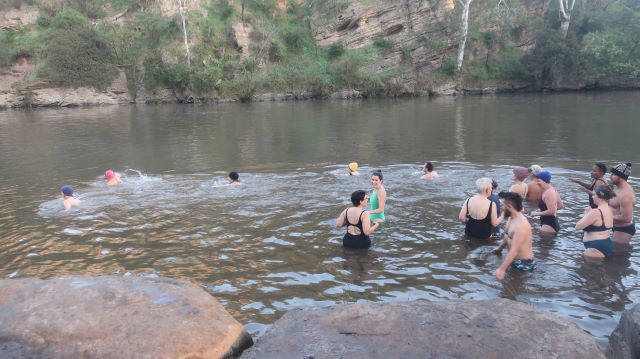
River swimming
Water quality in the Seine has been in the headlines at the Olympics in Paris.
Belgian triathlete Claire Michel fell ill and withdrew from the Olympic mixed relay. She has since confirmed that a virus, and not E.coli, was the cause of her illness.
In Paris, stormwater and wastewater (sewage) are combined. In Melbourne, we have separate systems, separate pipes, for stormwater and wastewater.
These far reaching decisions, taken at the end of the 19th century, are still playing out.
It is well known that Melbourne came to be known as Smellbourne in the late 19th century. Facing a public health crisis, the need for sewering the metropolis was urgent. At that time, infant mortality in Port Melbourne was twice that of St Kilda, and three times that of Brighton.1
There was debate at the time over whether to combine the sewage with stormwater runoff. Combined systems had the superficial advantage of only needing one set of conduits. Cheaper.
Whereas sewage has a predictable rhythm, stormwater is unpredictable. It can come in large volumes which overwhelm the capacity of the pipes and overflow into waterways. This might have been less of an issue with an open ocean with strong dispersive currents offshore. But Melbourne had just the calm enclosed waters of Port Phillip Bay, which would inevitably become polluted.2
Several cities around the world that had a combined system have retrofitted their cities to separated systems at great expense.
William Thwaites, architect and implementer of Melbourne’s sewerage scheme, building on the work of James Mansergh before him, decided that Melbourne would have a separated system and that no untreated sewage would be allowed to enter Port Phillip Bay.
After Paris was awarded the Olympic Games in 2017 they launched a plan to have water quality in the Seine swimmable in time for the Olympics.
Investment has been made upstream at wastewater treatment plants and in stormwater capture systems. Paris has also invested in fixing wastewater network connections that discharge raw sewage into the River.
They also built a vast underground storage basin under Gare d’Austerlitz which opened in May. It holds the rain water and releases it slowly after the rain has passed, also treating it before discharging it to the River. The basin can hold 50,000 cubic metres of water, the capacity of 20 Olympic swimming pools. It comprises a cylindrical structure 50 metres in diameter and 30 metres deep, supported by 16 pillars descending up to 80 metres underground – described as an ‘underground cathedral’. The storage basin was constructed in a highly constrained urban environment.
A potential future benefit is that stored water can be added to the river in dry summer months when the water level of the Seine is low.
The Olympics provided an incentive to galvanise investment, action and energy towards a swimmable Seine, a legacy for Paris post Olympics.
Meanwhile, the Hobsons Bay main sewer project is progressing, part of upgrading Melbourne’s sewerage infrastructure. The upgrade involves installing a duplicate sewer. When that is completed, sewage will flow through the duplicate sewer and rehabilitation work can be done on the existing sewer, built in the 1960s.
Lucy, the tunnel boring machine, has made her way under the River from Spotswood to Westgate Park where the old and the new sewer tunnels are being connected.
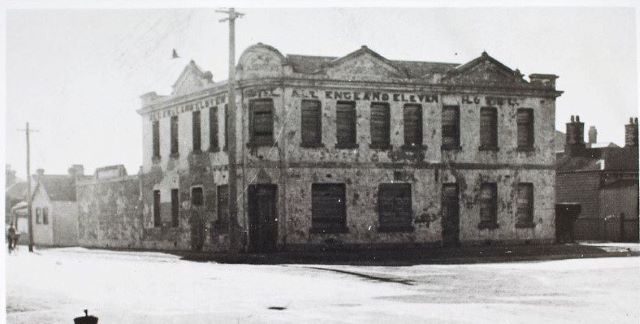
17 August marks the date when the All England Eleven in Port Melbourne (cnr Rouse x Princes Sts) was the first property in Melbourne to be connected to the sewerage system in 1897. .A plaque in the footpath commemorates this significant milestone in public health.
Notes
Sewage, comprised of 99% water, is the wastewater that leaves our kitchens, bathrooms, laundries and toilets, as well as from industry and businesses.
1 Dr Chris McConville at the opening of Growing Up in Port Melbourne 1920 – 1940
2 Richard Olive via email
Thank you to Richard Olive for his contribution to this piece.
2 Comments
-
-
Thank you so much Julie - your encouragement spurs me on.
-


Julie
Wow thank you again Janet. Every article you write is interesting and so relevant to our day to day lives in Port. I always look forward to reading each PP.